How it works
How the Marketing ROI Calculator works
 How the Marketing ROI Calculator works
Calculate campaign ROI and ROAS together, with gross margin and hidden costs in the maths — so a 3× ROAS that quietly loses money cannot slip past you.
Last updated Jul 29
Try Marketing ROI Calculator nowThe method
ROI = (revenue × margin − spend − other costs) ÷ (spend + other costs) × 100; ROAS = revenue ÷ spend. ROAS credits every rupee as profit, while ROI keeps only margin and charges all costs, so break-even ROAS = 1 ÷ margin — a "good" 3× ROAS at 25% margin can still be a loss.
Step by step
- 1
Enter the campaign spend and the revenue attributed to it.
- 2
Set your gross margin — the percentage of revenue you actually keep after delivering the product or service.
- 3
Add any other campaign costs: agency fees, tools, creative production.
- 4
Read the verdict, then compare the ROI and ROAS rows to see why they disagree.
- 5
Open “Show the maths” to check every step with your own numbers plugged in.
What it doesn't do
- Last-click credit: revenue attributed here gets full credit, so summing across a multi-touch journey overstates total ROI.
- No incrementality or LTV adjustment: some of this revenue would have happened anyway, and repeat purchases are not counted.
The maths behind the verdict
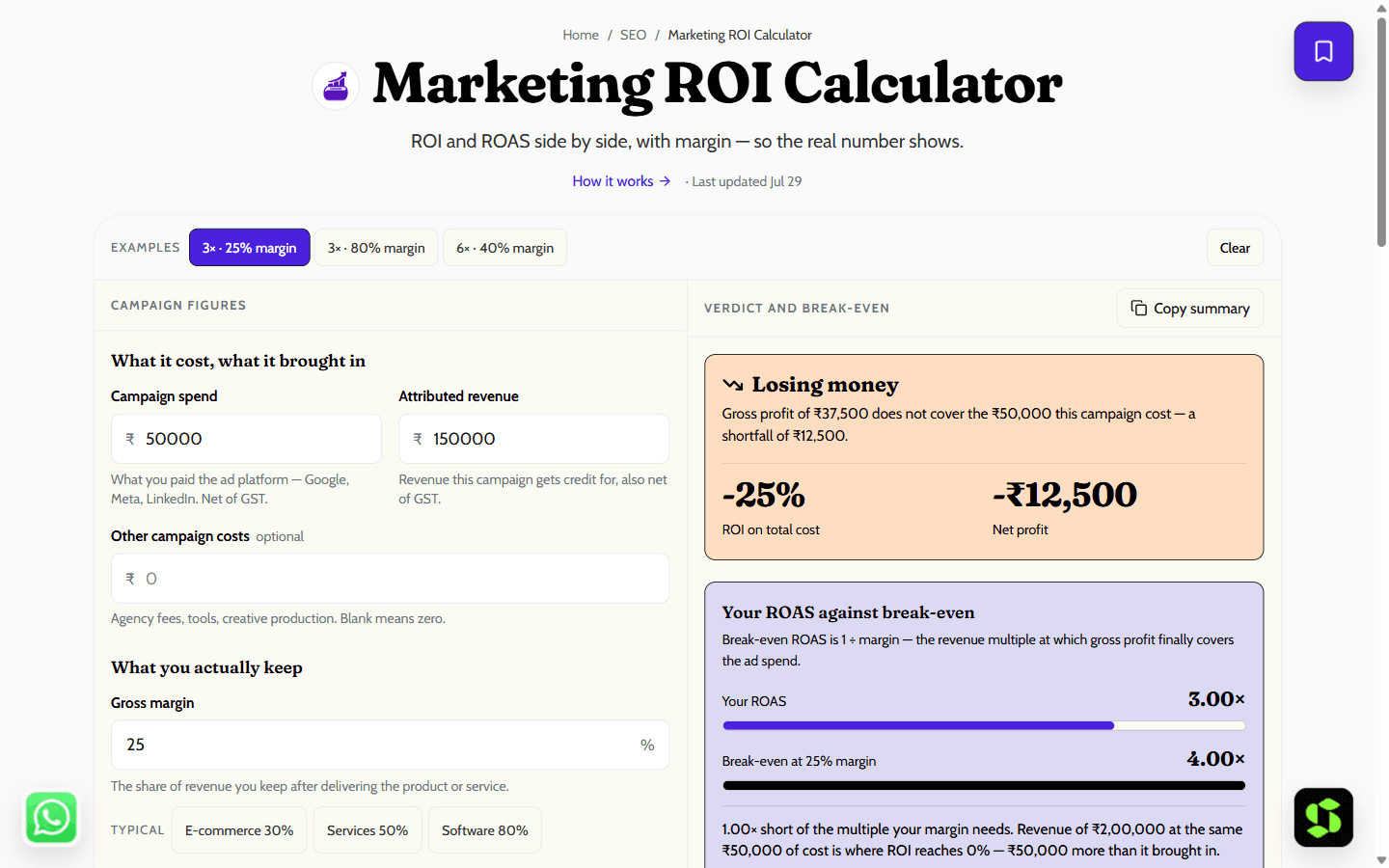
Spend ₹50,000, get ₹1,50,000 of attributed revenue back, at a 25% gross margin — a 3× ROAS that looks healthy on its own.
| Figure | Formula | Result |
|---|---|---|
| Gross profit | revenue × margin | ₹1,50,000 × 25% = ₹37,500 |
| Total cost | spend + other costs | ₹50,000 |
| Net profit | gross profit − total cost | ₹37,500 − ₹50,000 = −₹12,500 |
| ROI % | net profit ÷ total cost × 100 | −25% |
| ROAS | revenue ÷ spend | 3.00× |
| Break-even ROAS | 1 ÷ margin | 4.00× (needed just to break even) |
Same campaign, two opposite stories: ROAS says 3× and looks fine; ROI says −25% because it charges the 75% of revenue that never became profit. The gap is entirely the margin — which is why break-even ROAS (1 ÷ margin) is the number worth watching, not ROAS on its own.
Break-even ROAS at common margins — the ROAS you need just to cover costs:
- 50% margin → 2.00× break-even ROAS
- 33% margin → 3.03× break-even ROAS
- 25% margin → 4.00× break-even ROAS
- 20% margin → 5.00× break-even ROAS
- 10% margin → 10.00× break-even ROAS
Frequently asked
What is a good marketing ROI?
Above 0% means the campaign is profitable after margin and costs; most teams aim for 100%+ — two rupees of gross profit back for every rupee spent. The often-quoted 5:1 revenue rule only holds near 20% margins, so always compute with your own margin instead of borrowing a benchmark.
What is the difference between ROI and ROAS?
ROAS is revenue ÷ spend and ignores what the revenue cost you to deliver. ROI applies your gross margin and subtracts every campaign cost, so it measures actual profit. A 3× ROAS at 25% margin is a −25% ROI — the same campaign, two opposite stories.
Should GST be included in the revenue figure?
No. GST is collected on behalf of the government and passed through, so it is not revenue you keep. Including it inflates both ROAS and ROI — at the 18% slab, by nearly a fifth. Use revenue net of GST, and keep spend net of GST too so both sides match.
Why does the calculator exclude customer lifetime value?
Because LTV is the easiest way to make a losing campaign look like a winner: multiply first-purchase revenue by an optimistic repeat rate and everything turns green. This tool measures what the campaign actually earned. If LTV genuinely matters in your business, model retention separately with real cohort data.
What gross margin should I use?
Gross margin = (revenue − direct cost of delivering it) ÷ revenue. For e-commerce that means after COGS, shipping and payment fees; for services, after delivery labour. If you only know your blended company margin, use that — it is far closer to the truth than the 100% that a plain ROAS number silently assumes.
Is my data saved anywhere?
No. Every figure is computed in your browser as you type — nothing is sent to a server or stored.
Does it support US dollars or other currencies?
Not yet — figures are formatted in rupees only. The underlying maths (ROI, ROAS, break-even ROAS) works the same in any currency; just read the numbers without the ₹ symbol.
Need this built into your business?
This tool is free because it's a small, solved problem. If what you actually need is bigger — Google Ads management, built and maintained for you — that's Scult's day job.


