
Verified against ChatGPT · 2026-09-10
1987 friends photo at a restaurant table
Rexine booth seating, a formica table and a waiter’s flash — the night-out group shot with the hardest flash in the set.
The prompt
Ready to copy — highlighted parts are example details you can swap.
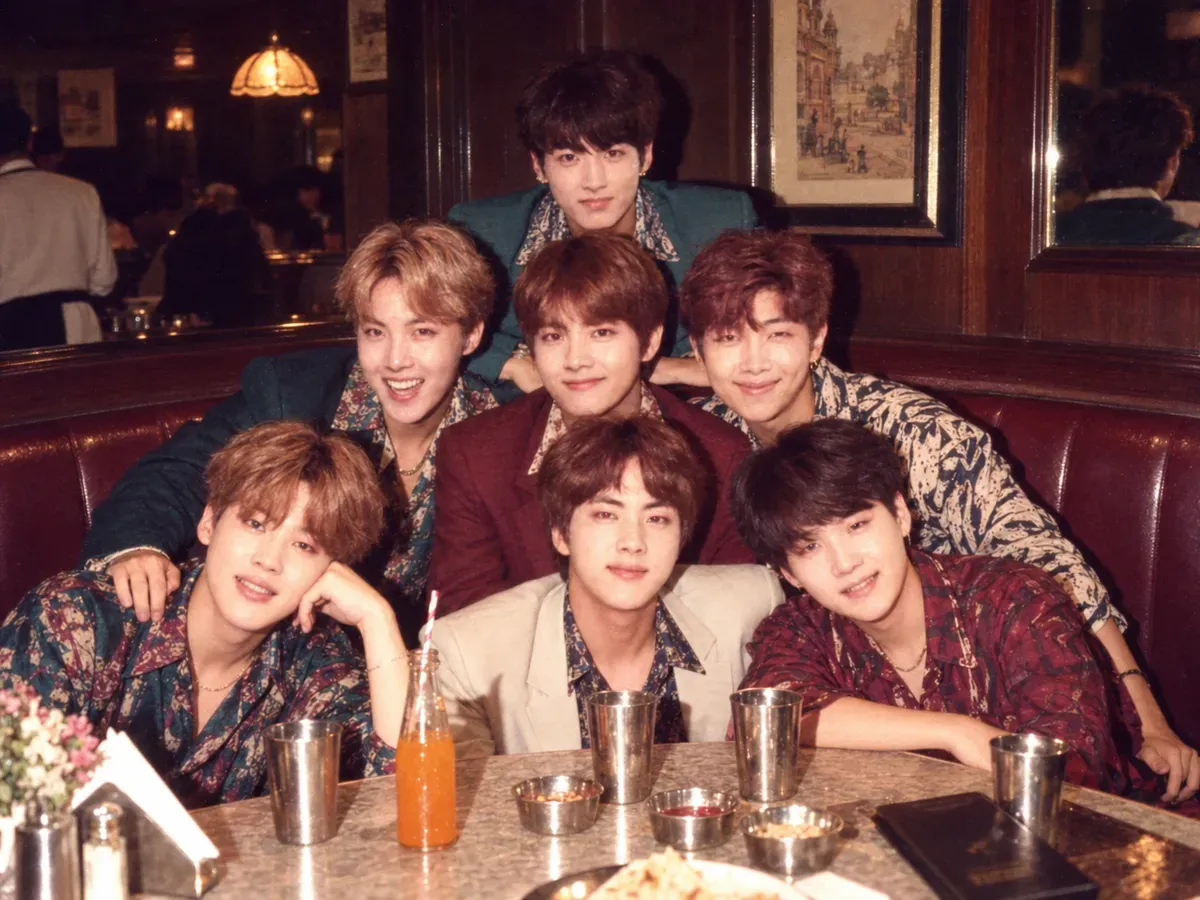
Use my uploaded photo. Count the people in it and render exactly that many — no more, no fewer. Anchor each face to its counterpart by left-to-right order. Do not merge, average, swap or blend any two identities. Keep each face exactly as it is — same features, skin tone, age and natural asymmetry, no slimming, lightening or smoothing. Every visible arm must connect to exactly one person, anatomically correctly, and every visible hand must have five correctly formed fingers or stay below the table edge. Change only hair, clothes, jewellery, pose and surroundings. Put us in a mid-range Indian restaurant in 1987, evening, squeezed into a curved rexine booth around one table, leaning in toward the centre and all turning to face the camera as a waiter takes the photo, with mixed expressions — two laughing, the rest smiling. Mid-80s going-out styling, varied across the group, crown volume, side partings, one big permed head, visible hairspray sheen. Smart evening clothes in bold prints of teal, maroon and cream — wide-collared printed shirts, a padded-shoulder blouse, a light blazer, statement earrings and thin chains. On the table: steel water glasses, a bottle of orange soft drink with a paper straw, small steel bowls, a formica top with a laminate pattern and a bill folder at the edge whose text is not legible. Behind us dark wood panelling, a wall mirror reflecting a partial back of a head, a framed print and a pendant lamp low over the next table. Light it with a hard direct unbounced camera flash fired from close range across the table: the nearest faces and the near edge of the table are noticeably brighter and slightly over-exposed while the people furthest from the camera are dimmer, a hard compact shadow falls on the booth backrest behind each head, and light falls off steeply so the rest of the restaurant is nearly dark, with a single warm pendant lamp glowing in the background. 35mm film at night with flash, 1987: grain, warm-magenta cast, halation blooming off the glasses, dense shadows, and slightly red eyes on one or two of us. No phone, no modern branding. Horizontal 4:3.
Take it further: the video prompt
Animates the photo above.
An image-to-video brief for Veo 3.1, Kling 3.0, Runway Gen-4.5 that continues this exact still, not a new scene — paste it alongside the generated photo.
Animate this exact still, not a new scene. Count the people in the still and animate exactly that many, anchored to the same left-to-right position as the still — every arm stays connected to exactly the same person as in the still, and every visible hand stays above the table edge or exactly as correctly formed as in the still. The only motion is the shared laughter continuing, the steel glasses on the table catching a faint afterglow from the waiter's flash as hands shift by a small amount, and the pendant lamp in the background flickering once; nobody's seating position changes. Camera: a locked-off tripod shot, no push, no pan. The hard direct cross-table flash must hold its exact falloff for the whole clip, so the near-to-far brightness gradient between us and the hard shadow behind each head on the booth backrest stay fixed. Keep the warm-magenta cast, the halation off the glasses and the film grain exactly as strong throughout. Add restaurant murmur and the clink of glasses, low in the mix — no directed dialogue, no music. Output: 5 seconds, one unbroken shot, no cuts, horizontal 4:3 matching the still exactly, loop-safe.
Why this works
A flash fired across a table produces a specific exposure gradient — near subjects hot, far subjects dim — that models will not reproduce unless the unevenness is named. Uniformly exposed faces are the default and exactly what makes a flash-lit group read as a modern composite. Red eye is the deliberate flaw: direct flash close to the lens genuinely caused it in 1987, almost nobody prompts for it, and a hint of it is very hard to dismiss as a filter.
What you get back
A hard flash-lit booth with a near-to-far brightness gradient, individual head shadows on the backrest, and a touch of red eye.
Verified against
ChatGPT GPT Image · 2026-09-10
Nano Banana / Gemini 3.1 Flash Image Gemini app · 2026-09-10
Changelog
- 2026-09-09 — Written for the September 2026 80s photo trend.
- 2026-09-10 — Rewritten as a single copy-and-go paragraph with no fill-ins, and paired with an example image.
Need this built into your business?
If a prompt isn't enough — what Scult builds, built and maintained for you — that's Scult's day job.
EXPLORE WHAT SCULT BUILDSMore Photo Trends prompts
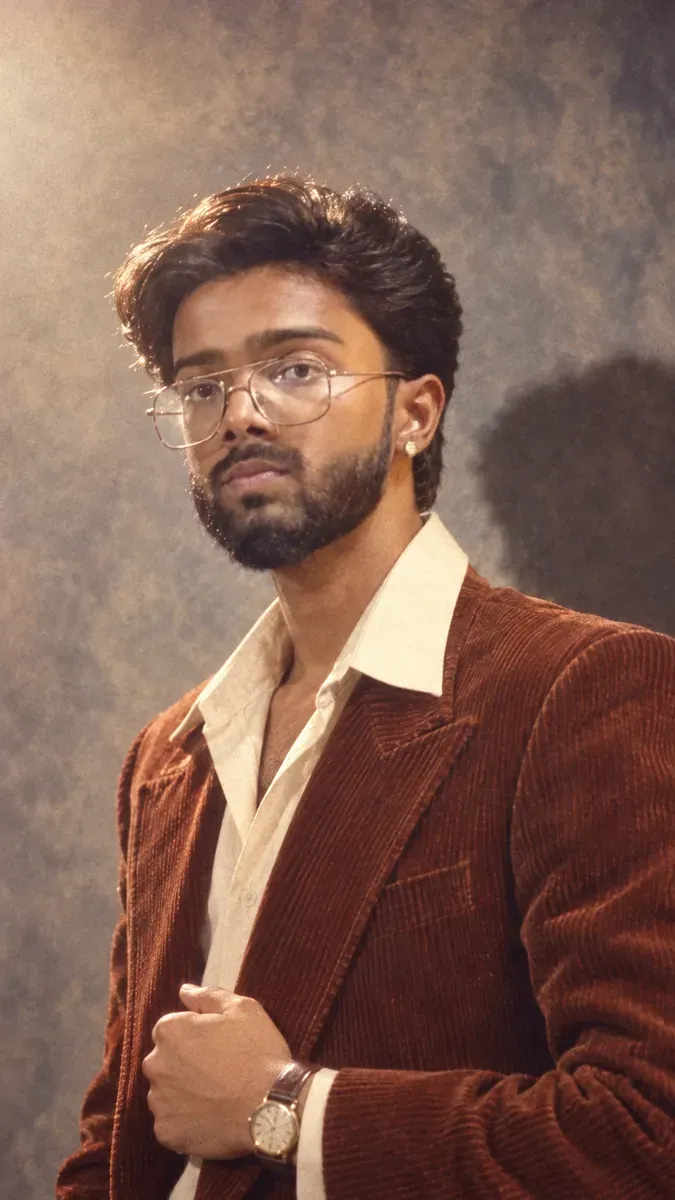 80s Bollywood studio portrait (men)The hard-flash studio portrait from mid-80s Hindi film publicity stills — corduroy blazer, mottled canvas, one hot light and a hard shadow.ChatGPT (GPT Image)Nano Banana (Gemini 3.1 Flash Image)2026-09-10
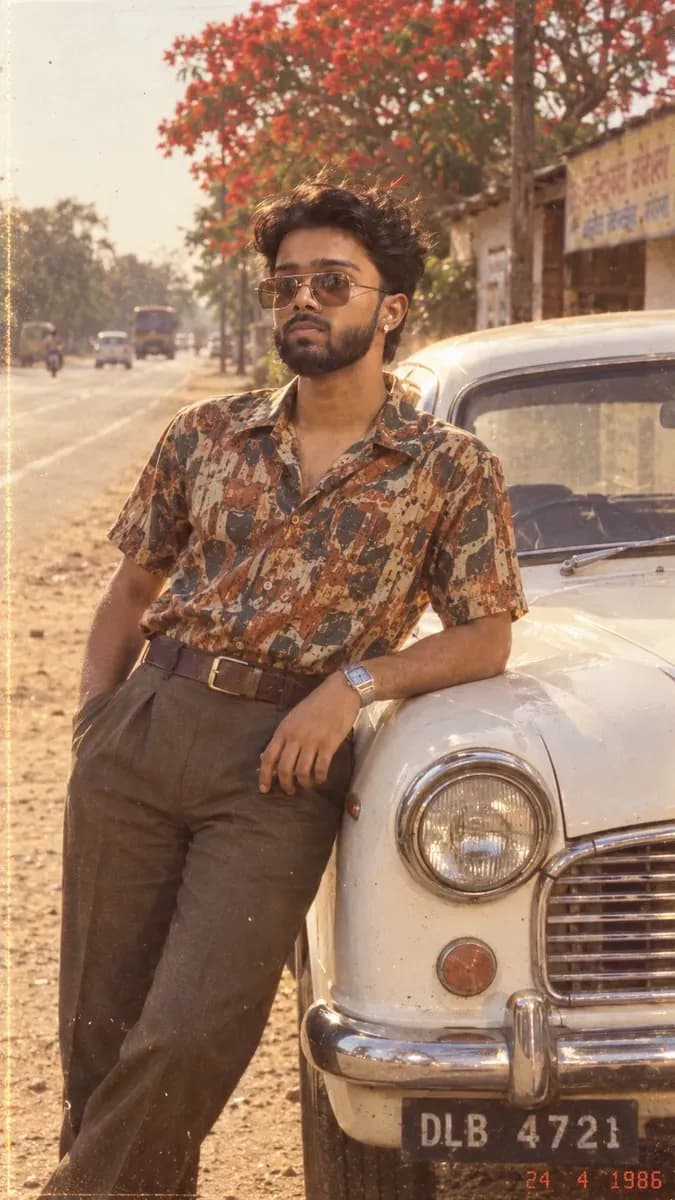 80s Ambassador car roadside portraitThe white Ambassador, the roadside, the late-afternoon sun — with the shape description that stops the model rendering a modern sedan.ChatGPT (GPT Image)Nano Banana (Gemini 3.1 Flash Image)2026-09-10
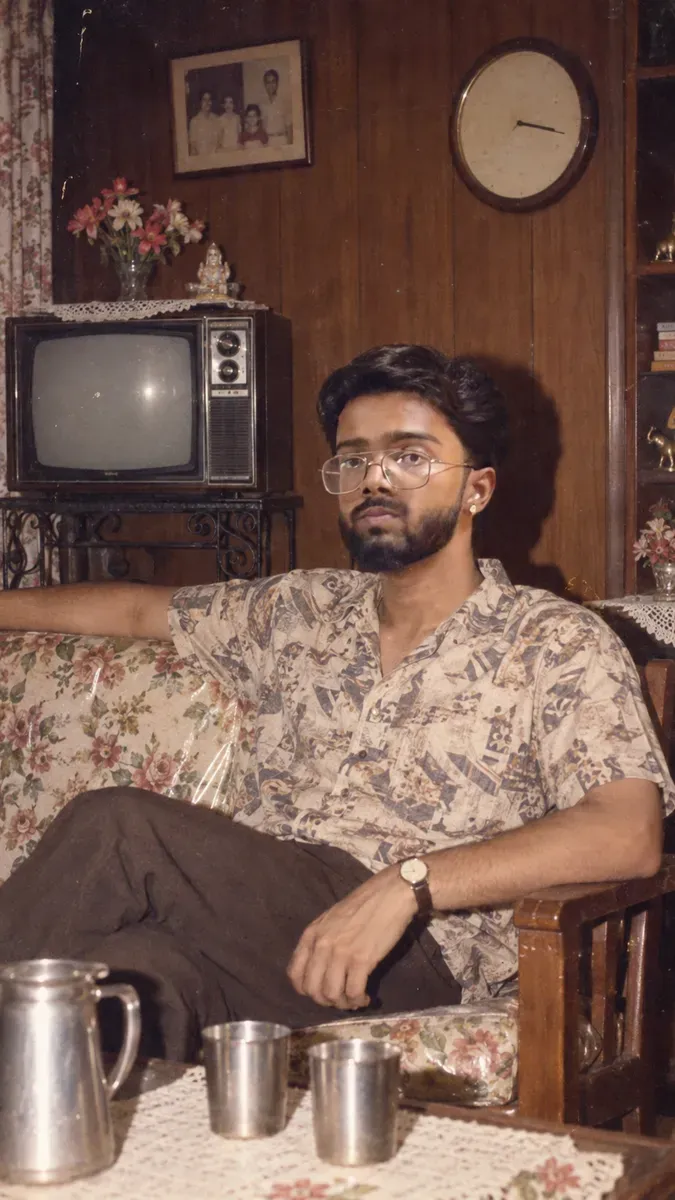 1986 Doordarshan-era living roomWood panelling, a boxy TV on a wrought-iron stand, plastic flowers and a direct camera flash. The middle-class Indian drawing room of the 80s.ChatGPT (GPT Image)Nano Banana (Gemini 3.1 Flash Image)2026-09-10
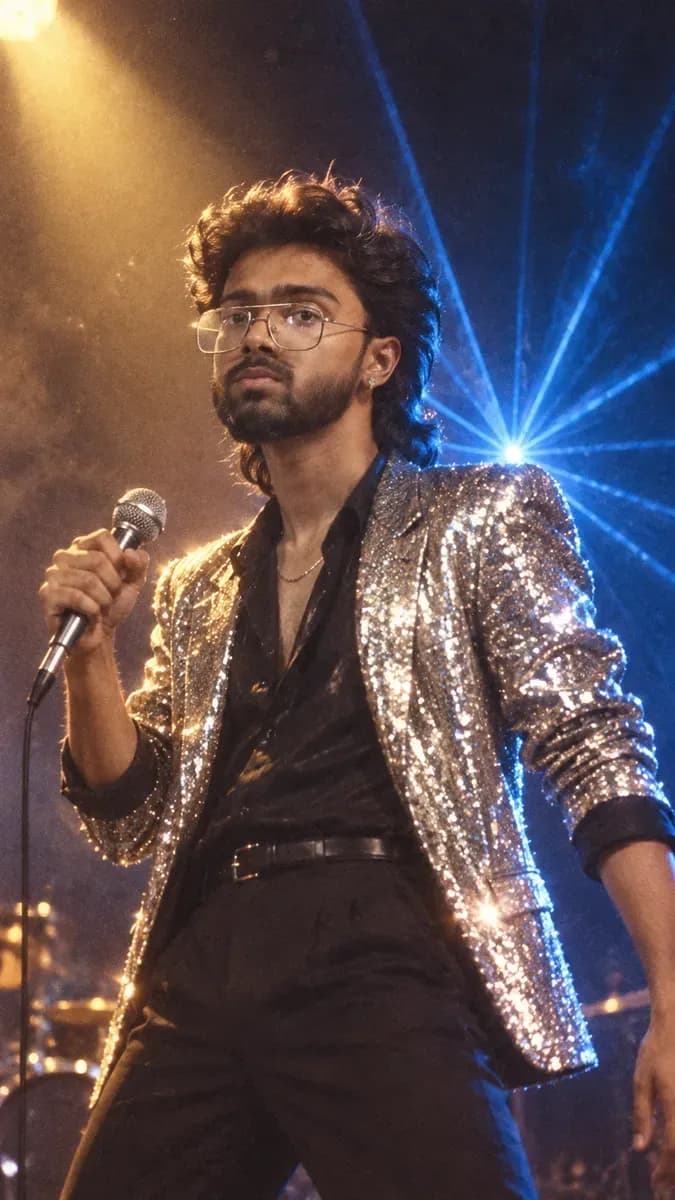 80s disco stage performerSequinned jacket, haze, a laser-starburst backdrop and a hot coloured rim light — with the colour discipline that keeps your face yours.ChatGPT (GPT Image)Nano Banana (Gemini 3.1 Flash Image)2026-09-10

