
Verified against ChatGPT · 2026-09-10
1986 film magazine cover (men)
Your face on a period Indian film-magazine cover, with the text instruction that stops the lettering turning into garbled AI type.
The prompt
Ready to copy — highlighted parts are example details you can swap.
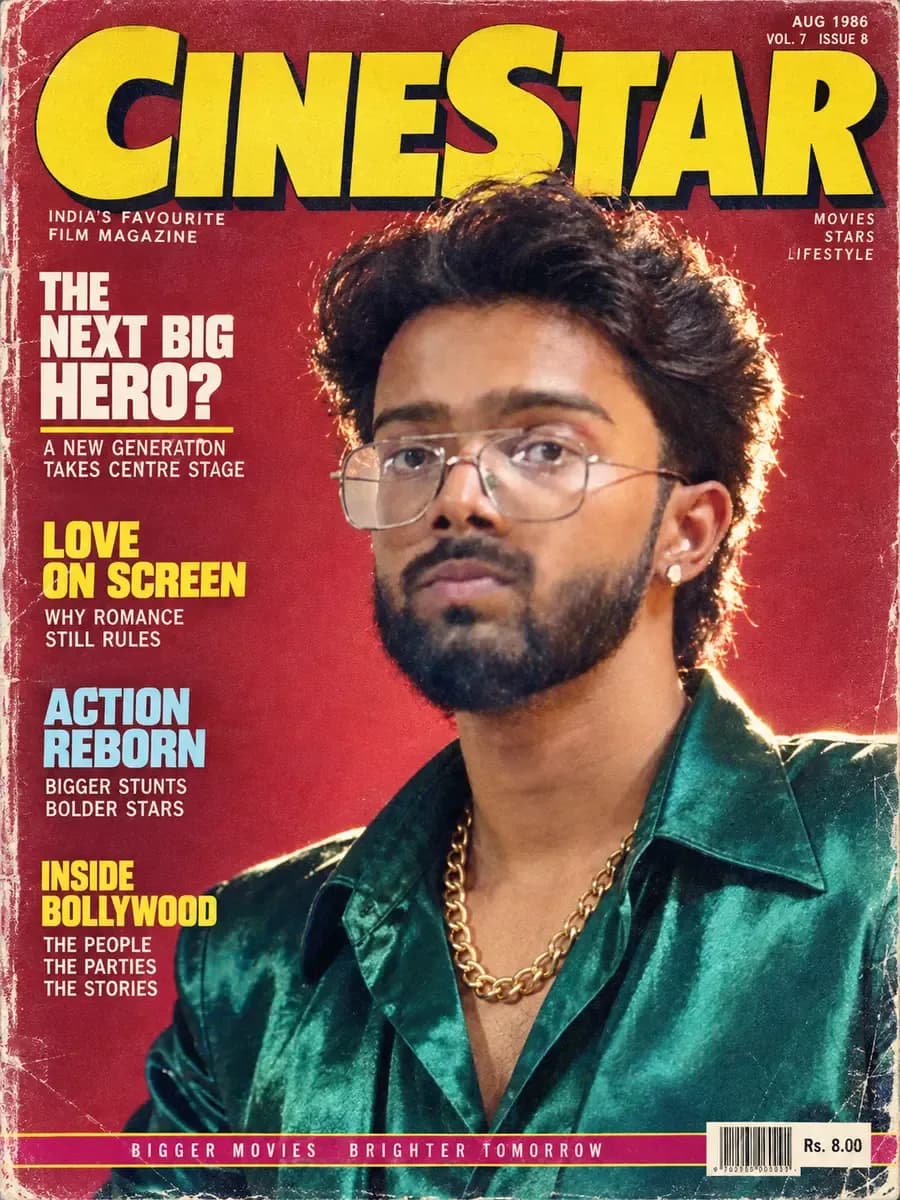
Use my uploaded photo. Keep my face exactly as it is — same features, skin tone and age, no slimming or smoothing, and do not stylise me toward a generic cover-model face. Change only my hair, clothes, pose and the design around me. Build a 1986 Indian film magazine cover on cheap glossy paper. I fill the frame from mid-chest up, slightly right of centre, looking straight down the lens, composed and confident. Mid-80s hair with crown volume, an emerald satin shirt with padded shoulders, a heavy gold chain. A bold sans-serif masthead across the top, its lower edge overlapped by the top of my hair, three or four short cover lines down the left edge, and a thin coloured rule with a small barcode and price at the bottom. Render the lettering as clean plausible English type, and where a word cannot be rendered crisply, render it smaller and softer so it reads as type at a glance rather than as sharp misspelled words. No Devanagari, no real magazine's name. Soft key just above the lens, bright fill from below, hard hair light behind, saturated paper backdrop. Oversaturated ink, faint halftone dots, slightly imperfect registration. Vertical 3:4 cover.
Take it further: the video prompt
Animates the photo above.
An image-to-video brief for Veo 3.1, Kling 3.0, Runway Gen-4.5 that continues this exact still, not a new scene — paste it alongside the generated photo.
Animate this exact still as a magazine-cover 'comes alive' teaser, not as a scene with a new background. Keep my face exactly as it is for every frame — same features, skin tone and age, no slimming or smoothing, and no drift toward a generic cover-model face. The only motion is a slow, natural blink and a faint catch of light moving across my hair as my head tilts a fraction of a degree; the masthead, the cover lines and the barcode stay perfectly still and exactly as legible or illegible as they are in the still, never re-flowing or sharpening into real words. Camera: a locked-off tripod shot, no push, no pan. The soft key above the lens and the hard hair light behind must hold their exact position and intensity for the whole clip. Keep the oversaturated print ink, the faint halftone dot pattern and the slightly imperfect colour registration exactly as strong throughout — the cover must read as printed paper the whole time, never as a clean digital render. No sound, or at most a very quiet studio-room hush — no music, no dialogue, nothing implying a cover story being read aloud. Exclude any Devanagari text, any real magazine's name, and any new lettering appearing. Output: 4 seconds, one unbroken shot, no cuts, vertical 3:4 matching the still exactly, loop-safe.
Why this works
Cover prompts live or die on text, and most published versions ignore the problem and ship garbled lettering. The fix is counter-intuitive: give the model a fallback. Telling it to render type smaller and softer when it cannot render it crisply turns the common failure — sharp, confidently misspelled words — into something that reads as ordinary type at normal size. Ruling out Devanagari trades a little authenticity for a usable image, since non-Latin script is where these models fail hardest.
What you get back
A saturated glossy cover with a masthead overlapping the hair, soft cover lines and visible print texture. The cover-line wording is near-nonsense up close, by design.
Verified against
ChatGPT GPT Image · 2026-09-10
Nano Banana / Gemini 3.1 Flash Image Gemini app · 2026-09-10
Changelog
- 2026-09-09 — Written for the September 2026 80s photo trend.
- 2026-09-10 — Rewritten as a single copy-and-go paragraph with no fill-ins, and paired with an example image.
Need this built into your business?
If a prompt isn't enough — what Scult builds, built and maintained for you — that's Scult's day job.
EXPLORE WHAT SCULT BUILDSMore Photo Trends prompts
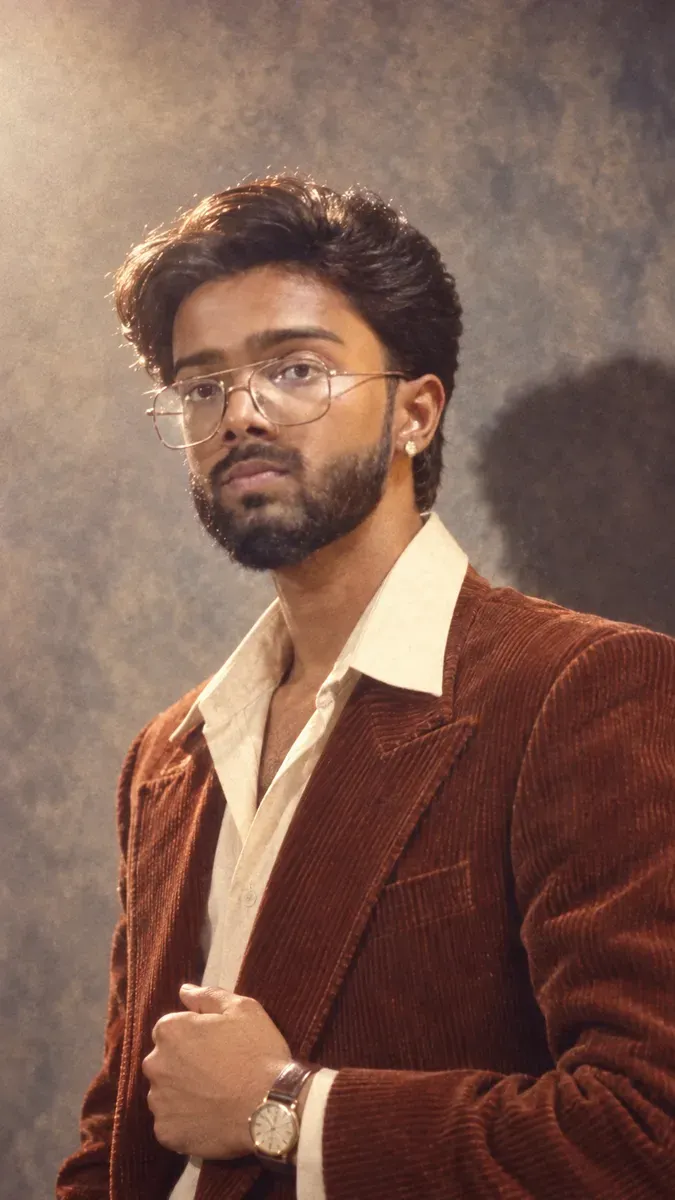 80s Bollywood studio portrait (men)The hard-flash studio portrait from mid-80s Hindi film publicity stills — corduroy blazer, mottled canvas, one hot light and a hard shadow.ChatGPT (GPT Image)Nano Banana (Gemini 3.1 Flash Image)2026-09-10
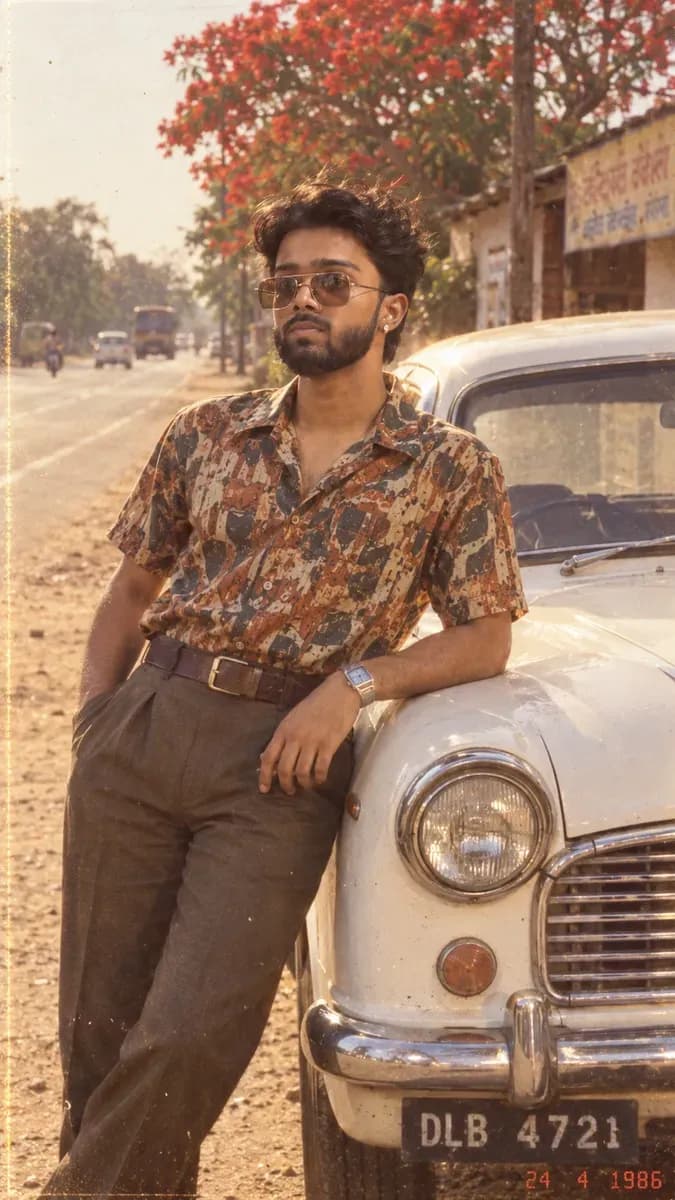 80s Ambassador car roadside portraitThe white Ambassador, the roadside, the late-afternoon sun — with the shape description that stops the model rendering a modern sedan.ChatGPT (GPT Image)Nano Banana (Gemini 3.1 Flash Image)2026-09-10
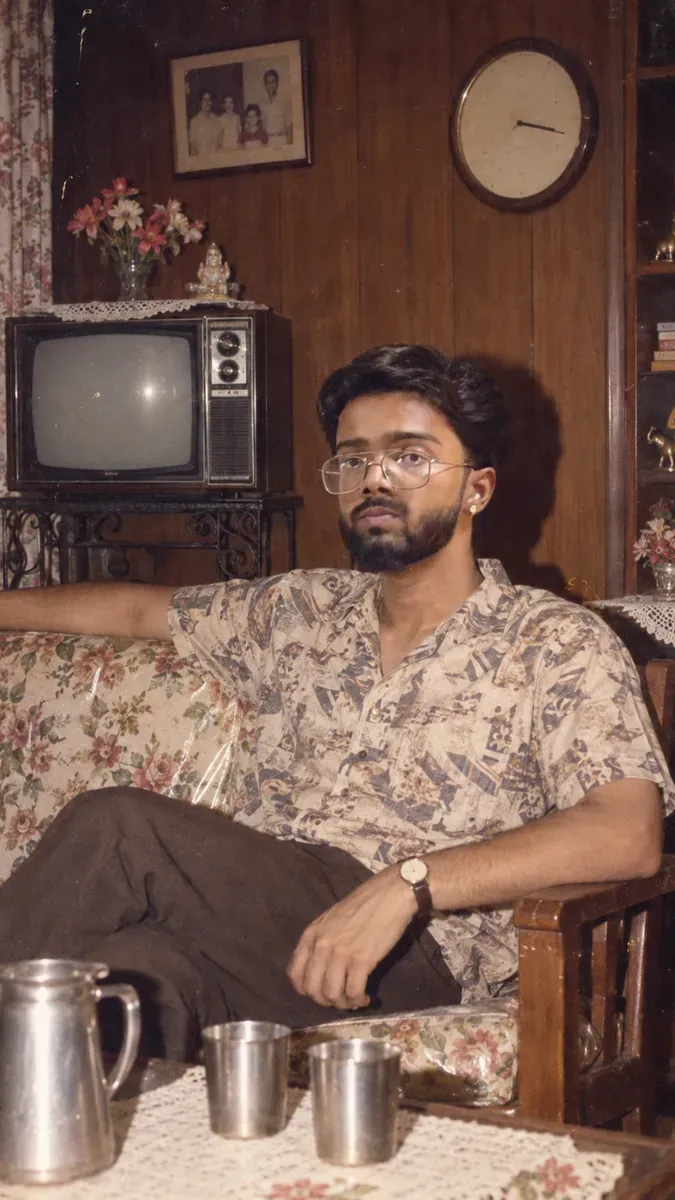 1986 Doordarshan-era living roomWood panelling, a boxy TV on a wrought-iron stand, plastic flowers and a direct camera flash. The middle-class Indian drawing room of the 80s.ChatGPT (GPT Image)Nano Banana (Gemini 3.1 Flash Image)2026-09-10
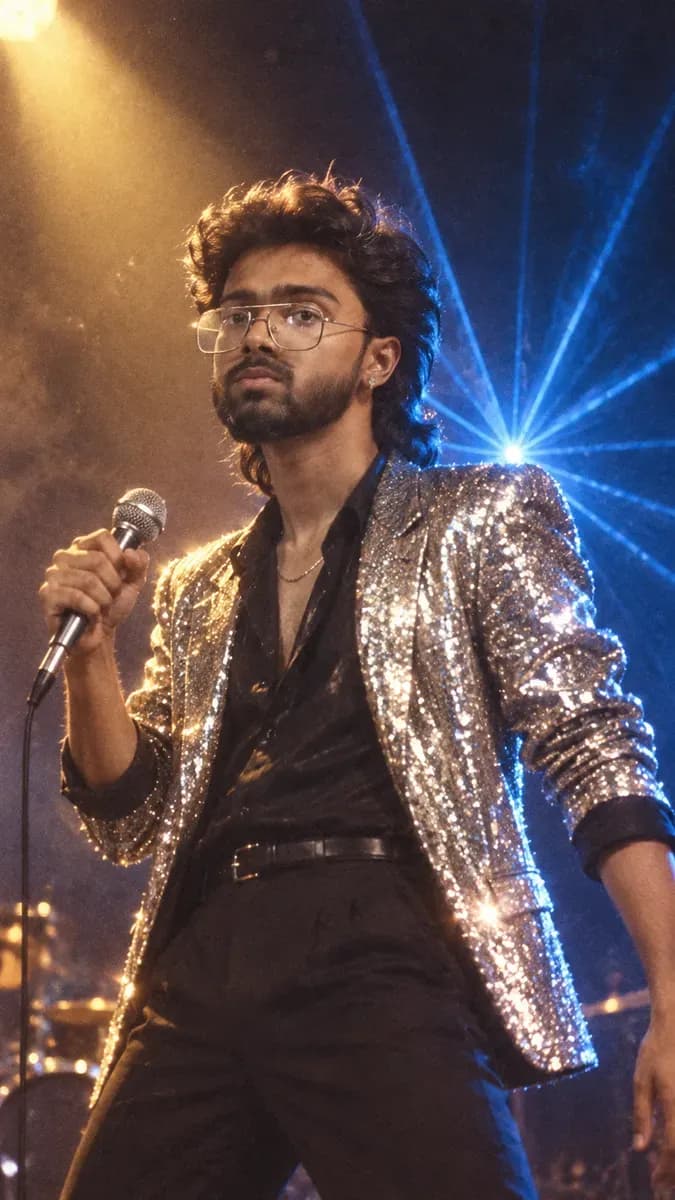 80s disco stage performerSequinned jacket, haze, a laser-starburst backdrop and a hot coloured rim light — with the colour discipline that keeps your face yours.ChatGPT (GPT Image)Nano Banana (Gemini 3.1 Flash Image)2026-09-10
